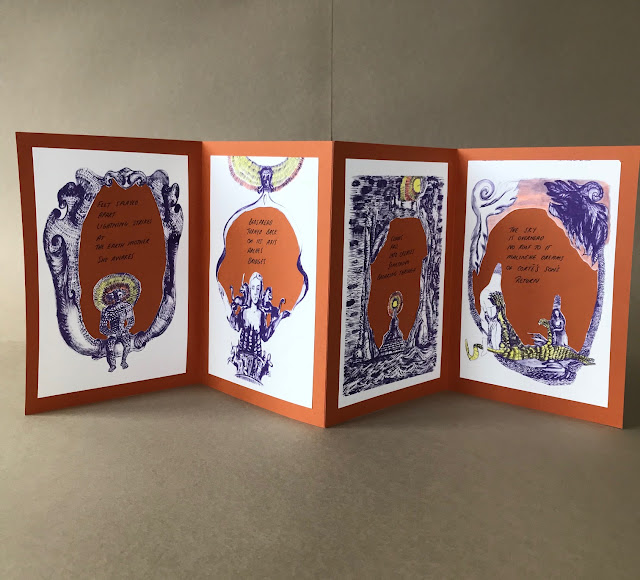
Monday, June 10, 2013

paper layers

A few posts ago, I mentioned how easy it is to achieve a 3d effect with paper by simply placing one tier of an illustration slightly proud of the one beneath it. A gorgeous example of this can be seen in Freya Blackwood's illustrations for a new picture book by Margaret Wild called The Treasure Box (Puffin: 2013).
The story, set during the Second World War, is about the one precious library book that survives the bombing of a European town where a little boy lives with his family. Before he dies, the boy's father entrusts the book to his keeping and the child buries it in a safe place beneath a tree. Years later, the son, now grown, returns to the place, unearths the book, and replaces it on the shelf of the rebuilt library in the town of his birth where it can be read and enjoyed by others.  


The illustrations cleverly tie into the book theme of the story. Freya Blackwood has collaged torn page fragments from a variety of books into the background of some of the illustrations in the book. She combines this technique with cut-outs of her watercolour images of people, buildings and scenery positioned on the page to create subtle drop-shadows and layered compositions. I've posted a few details below so that you can see how effective the illustrations are:


I'm very happy to have added this lovely book to my growing sub-section of children's books featuring paper-craft illustrations. 

Saturday, June 1, 2013

more paper play

I was supposed to be working on an art essay this afternoon, but the Su Blackwell book (see my last post) gave me the paper craft bug, so I decided to make a couple of collaged pop-up cards instead.


I cut out pictures from an old Time and Tune song book from 1958.


 Enjoy your holiday weekend!


paper tales

from Cinderella

Sometimes, when you least expect it, you come across a book that makes you catch your breath. I had that experience last weekend when I was browsing through the children's books at the Auckland Art Gallery shop and found a collection of paper-craft fairytales by English artist Su Blackwell.

The Fairytale Princess published by Thames & Hudson (2012) contains excellent retellings of seven classic stories by Wendy Jones, including my faves, The Princess & the Pea, Sleeping Beauty, and The Twelve Dancing Princesses, but the star of the production is Su Blackwell's three-dimensional paper scenes. 

 from Sleeping Beauty

For some years now Blackwell has used vintage books to construct elaborate paper scenes using a variety of paper-craft techniques such as papier mache and collage. I suppose it was only a matter of time before she put together a picture book, and what a book it is! 

 From The Twelve Dancing Princesses

From The Princess & the Pea

The paper scenes are photographed against atmospheric colour fields and the light and shadow play really enhances the magical nature of the tales. The illustrations combine details of scenes on single pages and double-page spreads of larger scenes.

  From The Twelve Dancing Princesses

 From Snow White

 From Sleeping Beauty

Su Blackwell's book is a triumph of paper-craft skill and a gorgeous piece of book production. I would happily recommend it to any fairytale lover or paper-craft enthusiast in your life.

From The Twelve Dancing Princesses

Saturday, May 25, 2013

a little 3d


I've really missed hanging out in the studio over the past few months, so Mother's Day provided the perfect opportunity to dabble in a little 3d paper play. 

I extracted an old calendar with illustrations of European castles from my basket of paper-craft goodies. Any image that has a tiered composition with background, mid-ground and foreground has the potential to be turned into a 3d model. It's just a matter of carefully cutting out each tier using a fine x-acto blade.

In this case, a stone wall separated the castle from the large public courtyard in front of it. You can see that by separating the background and foreground and holding one piece in front of the other, you immediately have a 3d model. Simple as that.

Here's another example of an image that has four tiers and can be turned into a more complex 3d scene. I'll probably make this one into a small model in a box.


To make a 3d card from the cut out image, you stick the back section of the scene to a folded backing card in a contrasting colour and attach a small tab to the front tier and stick it in place, like so:


Then, when you open the card, a cute 3d scene appears before you.

Wednesday, April 10, 2013

simmering projects


Graham Fletcher, untitled collage, 2009

A nearly full-time teaching workload this semester has kept me away from my lovely studio, but that doesn't mean I haven't been hatching ideas. We have three Pania Press projects lined up for the second half of the year when I'll only be teaching one paper at Massey.

Project One: 

A catalogue for an exhibition by Graham Fletcher at Melanie Roger Gallery in July 2013.

We produced a limited edition catalogue for Graham for his 2007 exhibition The Eternals. Each of the 45 copies (now sold out) contained an original drawing by Graham that corresponded to the 45 sculptures in the exhibition.


The limited edition catalogues for Graham's forthcoming show will each contain an original 'post-it note' collage, produced in 2009 while Graham was completing his Doctorate in Fine Arts at the University of Auckland. I was working on my PhD at the same time, and one day I popped into Graham's studio and saw a wall covered with cut-out pages from National Geographic magazines with brightly coloured post-it notes obscuring details of the image and text. 


When I asked about these unusual works, Graham told me that they were inspired by a curious discovery he made while researching at the University Library. When he checked out a PhD thesis by Peter Shand, 'Adrift on an Ocean of Affinities: Modernist Primitivism and the Pacific: 1891-1984' (1997), Graham noticed that certain images reproduced in the thesis were concealed by post-it notes asking readers not to remove them. The hidden images were of ceremonies and objects sacred to Aboriginal people, including a small woven basket (beneath the green post-it note below), which appeared alongside paintings by Australian artist Margaret Preston.


Graham responded to this novel act of censorship and concealment by cutting pages from National Geographic Magazines depicting various cultural groups from around the world, and then hiding the identities of the people depicted with post-it-notes, twink, marker pens, or a combination of all three.


I'm in the process of writing a lengthy essay for the catalogue that draws a connection between this series of collages and Graham's paintings in his ongoing Lounge Room Tribalism series. 

I'll keep you posted on developments as the publication date draws closer letting you know how you can go about buying a copy if you're interested.


I'll be back soon with details about our second Pania Press project for 2013.


the old days


The clear out of the basement at Jack's folks place has been like stepping back in time. How cute are these old Woman's Weekly's from the late 50s and early 60s!

Saturday, March 2, 2013

anatomy lesson

The next meeting of the writer's group I belong to is taking place in the surgery. It seemed appropriate to use these fantastic anatomical drawings from the 1940s to make the invitations for the meeting.


It's funny how the inside of the human body doesn't seem nearly as gross when it's drawn in all these pretty colours!


Saturday, February 16, 2013

small finds

A posy of 1960 Anzac Day poppies - the early kind that were made of fabric.

A worn out Mary-Lou.

A box of beautiful hand-carved Chinese figures that Jack recalls admiring in his grandmother's china cabinet. Some of the carvings have moving parts while others are static.


 It's such a treat to come across objects like these tucked away in cupboards.


 Have a lovely weekend!