Saturday, August 28, 2010

Manilla Castle - three views


Beyond 'Bright Star' and a Miscalculation

Now I know I promised a give away in today's post to celebrate my 100th post, but then I discovered that I'd actually only posted 95 times and that there were four draft fossils sitting among my blog archives. Fortunately, the miscalculation buys me a little more time to prepare my 100th post treat, but I can let you know that the giveaway will be a copy of our new title from Pania Press, a pretty five poem chapbook by Michele Leggott called Northland. We had hoped to release the book next week in time for the Home & Away poetry symposium in Sydney, but printer delays have set us back by a couple of weeks. Never mind - experience has taught us that no publication ever runs smoothly, so you just have to roll with it.

In the meantime, I've deleted three of the draft fossils, but I thought I'd quickly finish off this one that I started after watching the film Bright Star earlier this year:


Seeing the wonderfully detailed shots of Fanny Brawne handstitching her linen dresses and accessories in Jane Campion's film Bright Star (about the relationship between poet John Keats and Fanny Brawne) made me want to come home, dig out my embroidery hoop and thread from the craft cupboard and get sewing.

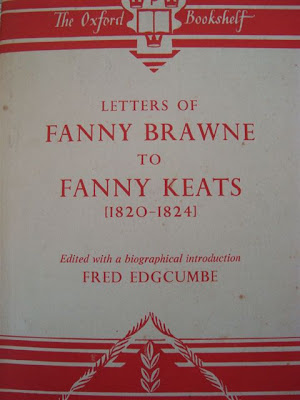
The movie also made me want to learn more about Fanny because the passionate creative and intelligent character represented on screen was a far cry from the longstanding portrayal of Fanny as a cold -hearted vixen who cruelly spurned Keats' love. Luckily Jack's vast library contains a slim volume of 31 letters written by Fanny Brawne to Keats's younger sister, also named Fanny (Frances). Keats had asked Brawne to correspond with his sister when he became too ill to write in the last months of his life and the letters between the two women continued for three years after his death.


The letters are so lovely and so sad. Three days after Keats died in Rome on 23 Feb 1821, Fanny Brawne wrote to his sister:

I know my Keats is happy, happier a thousand times than he could have been here, for Fanny, you do not, you never can know how much he has suffered. So much that I do believe, were it in my power I would not bring him back. All that grieves me now is that I was not with him, and so near it as I was... for it is now known that his recovery was impossible before he left us, and he might have died here with so many friends to soothe him and me me with him. All we have to console ourselves with is the great joy he felt that all his misfortunes were at an end...

The letters tell the story of the friendship that developed between the two young women in the wake of their shared tragedy. I particularly like Brawne's charming accounts of her everyday life and the sisterly advice she gave to Fanny Keats who was in the care of very strict guardians who withheld money from her and seldom let her leave the house or entertain visitors. A couple of the letters contain drawings of Brawne's latest dress designs along with suggestions to Fanny Keats about sleeve and bodice detailing, the best choice of fabrics, and decorative uses for lace:

handsewn sleeve pintucks in a repurposed kimono

Inspired by the film and my reading of Fanny Brawne's letters, as well as a gift from my sister of four silk kimonos from a glorious shop in the heart of Kilbirnie, I plan to experiment with handsewn detailing and see what new things can be created from these lovely traditional garments.


Thursday, August 19, 2010

Inspired by Elsita

Whenever I want to try out a new paper craft, I look for the best example of a particular technique in a book, or in blog land, and attempt to make a simplified version. Then I decide whether I have the ability to pursue it further and develop my own designs. Personally, I find this a more effective and pleasurable way of learning new skills than reading complicated instructions in a book or attending a workshop.

If you want to learn about the technique of paper-cutting you can't go beyond the exquisite and magical work of Elsita Mora. Her imagination is boundless and her attention to detail astounding. My paper girl (shown above) is a rough first attempt at paper-cut illustration inspired by Elsita. What I've learned is that you have to be very skillful to draw with a blade and you also need to be patient and cut away tiny pieces of the image at a time to avoid making mistakes.

The reason I wanted to learn this skill was to use it in combination with a simple 3-d form to create a double oval portrait for my pop-up Snow White:


According to my blogger dashboard this is my 99th post. To celebrate my 100th post on Mosehouse Studio I'll be offering a special give away, so if you drop by again in the next week or so, you'll find out all about it.
Enjoy the rest of your weekend.


Monday, August 16, 2010

red, white and black

You just can't beat the colour combination of red, white and black for a bold visual effect. Here are the first two pop-up illustrations for my adaptation of Snow White told from the Mirror's perspective. It's difficult to show the layers in a photograph, so here are a few views to give you an idea of how they're put together.