Sunday, January 30, 2011

scraps


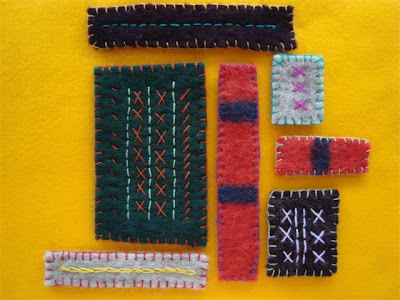
My low waste approach to crafting means that I inevitably end up with bags and bags of scraps. Wallpaper scraps, textile scraps and cardboard scraps fill the cupboard in my overcrowded workroom. I particularly hate to waste felt scraps. After all, it takes an hour of hard labour to make one 30cm felt square, so I'm reluctant to throw any part of it away. In the evenings I've started to blanket stitch around the edges of the odds and ends and to decorate some with rudimentary embroidery.


Even scraps have their uses

As a nice closure for a felt pouch, for instance.

Friday, January 28, 2011

Fold 3

This week I've been experimenting with making small models out of paper in preparation for making more complicated 3d scenes that incorporate stand-alone features, like this bridge, as well as pop-up technology, like this church:

In the quest to master more and more dazzling techniques with paper, it's good to remember that the simplest pop-up forms are often the most effective, and that even the most complex pop-ups derive from the simple fold / cut / fold back principle.


Experimenting with paper craft, according to Sadami Yamada and Kiyotada Ito, leads to 'a planned development of your powers of observation and your sensitivity to plastic forms and a gradual growth toward orginality...' Having attained these, 'you will be able to bring poetic and romantic materialisation to the images that flow forth from your inner self. You will be able to discover beautiful forms. These things also nurture vital elements in growth in knowledge of the functional and physical makeup of things.'

Now that's a goal worth working towards isn't it.

Have a great weekend!

Friday, January 21, 2011

Fold 2


A couple of days ago, I found the most stunning Japanese paper craft book in a second hand bookshop (published by Isaac Pitman and Sons, London, 1967).
It's one of those books that makes you want to get busy crafting immediately because everything in it is so amazingly designed, from the sophisticated simplicity of a paper lounge suite, to the imposing figure of a paper horse with a wide flowing mane. Only a selection of the works are accompanied by instructions on how to make them, but the beautifully shot full-page black and white photographs make it easy enough to work out how to create many of the other objects in the book, or better still, learn how to apply the various techniques to your own designs. Here's a sampling of some of the other pieces in this fantastic book:

Fold 1

Calico bookcloth is my new favourite material. It folds beautifully, it doesn't fray, and it has the crisp texture of starched fabric. Perfect for making elegant envelopes.

Tuesday, January 18, 2011

Pale Star

In the hectic lead up to Christmas I didn't get a chance to complete a special book art project for Jack. It has become something of an annual tradition, and a nice way to show how much I appreciate Jack's writing, so I was unhappy about missing a year. Still, figuring that it's better late than never, I made time over the past couple of days to make a little something inspired by Jack's poem about Katherine Mansfield. This is the text:

Pale Star
K.M., 1923

(after Xu Zhimo)

Unintentionally imitating Chinese style
her hair was pitch black & straight

Her features seemed to me
like the purest Indian jade

or pristine snow in the Alps
Her brightly-coloured clothes

might have aroused some criticism
had they been worn by anyone else

on her they looked becoming
like green leaves on a flower

Her figure was so fragile
that a man standing beside her

felt his breathing to be too coarse


(Jack's amusing account of how this poem came about can be read at our Pania Press blog)

For this design project I wanted to try something similar, but much less detailed, to Jayme McGowan's spectacular 3d papercraft scenes that you can see by visiting her blog, Roadside Projects.
I based my illustration on a grainy photograph of Katherine Mansfield (shown above) taken in 192o in her writing studio at Menton. She is seated at a table wearing a jersey with a wide striped collar and she's holding a cup of tea. The wall behind her is papered in a nice geometric print with dashes and dots. Here's a photo-narrative of the project:

I really enjoyed making the 'Pale Star' picto-poem, so much so that I'm going to try something similar with one of my sister's poems next...

Friday, January 14, 2011

small things

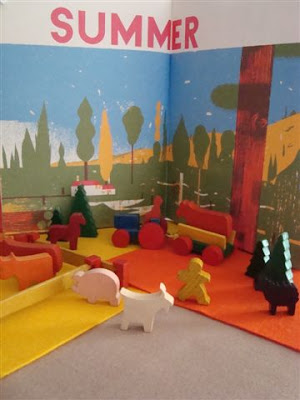
I recently found this tiny wooden farm in a second hand shop in Tawa. The background to the shot is an illustration from the beautiful Gecko Press book Seasons by Blex Bolex, a much appreciated prezzie from Gabriel and Lies.

Among Lies's many creative skills, she happens to be an amazing knitter. She documents her projects here. Drop by for a look - I promise you, you'll have the knitting bug in no time at all. I was admiring one project featuring knitted origami booties, which you can view here. I wondered whether they would work as well in felt, so I made a pair in grey merino roving that I felted with a red stripe through it. When the booties are sewn together they look like they've been dipped in red ink, which is cute. They'll make a nice gift for our friends Ellen and Brett who have their first baby due in winter.

The start of a paper mouse - a new project perhaps... The image in the background is from the 1966 Mother Goose Treasury illustrated by Raymond Briggs.

And my favourite small thing - Zero resting in the wheelbarrow after an exhausting day watching me weed the garden.

Friday, January 7, 2011

DOLLS (in three parts)

Part One: The Bren Collection

I wouldn't describe myself as a doll enthusiast, and yet three doll related items have come my way over the past few months, the sum of which forms my first blog post of 2011. Happy New Year everyone!
The image above is a detail from the award winning catalogue produced by the Hawke's Bay Museum in 2009 to accompany a display of items from the collection of the Reverend Robert Bren, comprising some 2000 miniature objects, some made by him, and others bought in London in the 30s and 40s, which were later gifted to the Museum by his wife.

The catalogue is gorgeously designed. The cover features a centrally opening gilt gate with perforations that allow you to glimpse the five miniature dolls from the Bren collection that are the subject of the 'Blytonesque' story by Stephanie Johnson that forms the content of the catalogue. The story is printed in a small booklet attached on an angle to the larger backing sheet. A clever tab attached to the central fold makes the booklet spring up when you open the catalogue.

I regret that I wasn't able to make it to Napier to see the exhibition, but at least the catalogue captures some of its magic, and reading it certainly rekindled childhood memories of rainy Sunday afternoons in Napier when we would visit Lilliput and look at the model town with all its teeny inhabitants fixed in place. A train chugged around the perimeter of the town, making its way past patchy astroturf hills, fields and farms, and went tooting through a tunnel or two to complete the circuit. As far as I recall, the walls of the musty smelling room were lined with glass vitrines filled with puppets and dolls of every kind. I'm not painting a very appealing picture, I know, but at the time I thought it was all very magical and enchanting. Here are a few more cropped images from the catalogue (if you're very clever you might be able to spot my own miniature tea set in one of them):

If miniatures are your thing, then the catalogue is well worth owning. The Miniatures: An Adventure in the Bren Collection costs $8.00, and Jack ordered a copy for me for Christmas by contacting the Hawke's Bay Museum and Art Gallery directly and they very kindly posted it to him.
While we're on the subject of miniatures, I'd also like to recommend Lauren Child's retelling of Hans Christian Andersen's story The Princess and the Pea, not so much for the text itself, which I found far too wordy, but for the glorious doll's house sets used to illustrate it, splendidly photographed by Polly Borland:
An account of the collaborative process between Lauren Child and Polly Borland is described in the inside back cover of the book. Reading it made me want to invent a miniature storybook world of my own, one of the many exciting projects I hope to get to in 2011.


Part Two: Lily's Book

On my last trip to Onehunga's Hard to Find Bookshop, I was browsing through the craft book section, and I came across this book by Gwen White published by Mills & Boon in 1962. The author visited Museums throughout the UK and beyond to research dolls in their collections, which she has beautifully sketched in watercolour and coloured pencil to illustrate this lovely volume. Here are some of my favourites:

1. Two fruit vendor dolls from Brazil. 2. (Left) Doll from Las Palmas, Canary Isles (Right) Boy doll from Morocco. 3. Dolls from Egypt. 4. Welsh doll called Jenny Morgan. 5. English wooden doll. 6. Maori dolls made of linen. 7. Two of Queen Victoria's dolls (Left) Lady Maria Arnold (Right) Mlle Proche.

One of the things I like most about buying books secondhand is finding evidence of the book's earlier life. Sometimes there is a bookplate pasted into the flyleaf, or a written inscription if the book was a gift, but best of all is when you discover ephemera inside the pages of the book that tells you a story about the person who once owned it. When I first opened Dolls of the World I saw that it had been a birthday gift in 1965 to a woman named Lily from her sweetheart Robbie, and then I found all of these doll-related articles that Lily had snipped from magazines and newspapers over a period of twenty years or so:

It was such a treat to read all the articles. There are some fantastic quotes in them. One elderly American woman called Beatrice Alexander, famed for her historically accurate and exquisitely detailed costume dolls, told a journalist that she had always been rigidly honest in her work. 'I've never cheated by sticking something when it should be stitched, or trimming a dress with two buttons instead of three. You can't be slightly honest just like you can't be slightly pregnant. It's one thing or the other.' That seems like a pretty good rule to live by, doesn't it.

One of the articles has a grainy picture of a 19th century French mechanical doll dressed in pink satin. Apparently, when it is wound up the doll plays a waltz, bows her head, and offers you fruit while a tiny doll dances on the tray she is carrying. Now that's a doll I would like to see!

There's an article from 1973 about a Piha woman by the name of Joan Kingston who had the second largest collection of dolls in New Zealand, and the 3ft high, three storey Victorian Doll's House in her collection was used in the film adaptation of Katherine Mansfield's short story, 'The Doll's House'. One of the prize pieces in Joan Kingston's collection was the tiniest jointed doll ever made, measuring just five-eighths of an inch in height!

Another article told the story of an English mortorcycle shop owner who became an accidental doll collector after renting a building that had formerly been a doll's hospital. People would come to his shop with broken dolls that needed mending. Being a kind hearted sort he would fix the dolls, an activity that gradually turned into a passion and grew into a collection of over 400 dolls that took over his home and his life.

I have loved reading Lily's book as well as the doll-related ephemera she carefully tucked inside the pages. Wherever she is now, I hope Lily knows that her book has found an appreciative new owner.


Part Three: Better than Star Wars

I remember clearly when Star Wars hit the big screens in New Zealand because I didn't get to see it. I was in hospital with a ruptured appendix and my brothers got to go and see the movie without me. I was very unhappy about it, so Dad went to the shops and bought two tiny little dolls for me. They had movable limbs and I remember they were dressed in woolly coats with pink felt bonnets.
I rediscovered the dolls recently when we were helping Mum move into a smaller unit. It's a year now since Dad died, so she felt ready to make the move. The elastic holding the dolls' limbs together had long since perished along with their clothes, so I thought a nice way to commemorate Dad would be by making new outfits for the dolls he bought me to brighten up my day all those years ago.
Firstly I repaired them and reattached their arms and legs with thin elastic and then I fashioned each of them a little frock from two embroidered linen doilies. Much better!