Saturday, March 31, 2012

written in sand

 The start of a sand text composed yesterday by the poets
involved in the 'Short Takes on Long Poems' Symposium.
Photos taken by Jack Ross

'Begin Anywhere' - what a great mantra for any aspiring creatives.

Sunday, March 25, 2012

Stock


I've had a busy but very pleasant weekend making up some Pania Press stock for a book table that I'm overseeing at a Trans Tasman Poetry Symposium taking place at Auckland University this coming Thursday and Friday. The Symposium is called Short Takes on Long Poems .  Click on the link to find out all about it.

I thought I'd present an eye-catching display of a few different kinds of Pania publications, rather than opting for the usual sort of neatly stacked piles of books that are the norm at these kinds of events.

 There will be three 'Lounge Room Tribalism' collage poems


Five 'Britain's Missing Top Model' collage poems

  The last five copies of Love in Wartime which I made new cross-stitched wallpaper covers for.


 Five copies of Michele Leggott's Northland

And if time permits between marking student assignments, I hope to make up a few copies of this pop-up prototype of a poem called 'Ferris Wheel' written by my sister Therese Lloyd:

I was amazing a crowd of gentle revellers
When I realised I'd answered yes
To the wrong question
A spoke forked off the Ferris wheel
And I dangled from it
I noticed the stillness and distance
Of both sky and land
In the middle
I gave height to nothing

Have a productive week!

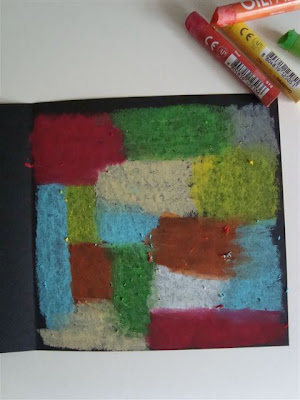
pastels

My sister sent me a box of oil stick pastels last year. I thought I'd use them to decorate the batch of black paper envelopes I made to send off my newest short story to my writers' group.


Thursday, March 22, 2012

flying books

I should have known that the amazing creative mind of children's book writer and illustrator, William Joyce, was behind the Academy Award winning animated short film The Fantastic Flying Books of Mr Morris Lessmore. 

William Joyce's picture book A Day with Wilbur Robinson (1990) was the book that began my collection of sophisticated children's picture books back in 1993.
 
If I was hosting a fantasy dinner party of contemporary children's book writers and illustrators then William Joyce would be at the head of the table sharing a place with Maira Kalman.  


They both manage to pull off that incredibly difficult combination of writing great stories (engaging, fanciful, funny, not too short, not too long) combined with pictures that are uniquely theirs, and that bring their stories to life on the page.


Anyway, here's Moonbot Studio's blurb about The Fantastic Flying Books of Mr. Morris Lessmore :


'Inspired in equal measures, by Hurricane Katrina, Buster Keaton, The Wizard of Oz, and a love for books, "Morris Lessmore" is a story of people who devote their lives to books and books who return the favor. The Fantastic Flying Books of Mr. Morris Lessmore is a poignant, humorous allegory about the curative powers of story. Using a variety of techniques (miniatures, computer animation, 2D animation), award-winning author/illustrator William Joyce and Co-director Brandon Oldenburg present a hybrid style of animation that harkens back to silent films and M-G-M Technicolor musicals. "Morris Lessmore" is old-fashioned and cutting edge at the same time.'

Follow this link to be transported to a wonderful alternate world for the next fifteen minutes of your life. I've just returned from the journey and the world seems just that little bit more magical and brighter now. Bright enough even to stop procrastinating and head to the office to mark student essays.

You can find out more about the film here

Enjoy!


Sunday, March 18, 2012

THE HOLE


These days, it's mighty rare for any art or cultural activity happening in the city to be enticing enough for me to abandon my precious Saturday of writing, sewing or crafting, spruce myself up, and catch the bus over the Harbour Bridge and into town. Yesterday, however, was an exception.

Last week, I received an email from Hopkinson Cundy Gallery advertising their latest exhibition by Auckland artist Luke WillisThompson with the run-together title inthisholeonthisislandwhereiam

What intrigued me about the promotional statement for Thompson's show was the news that the gallery was to be vacant for the duration of the exhibition (15–31 March 2012), and that the work itself was a property in Epsom which visitors would be transported to by taxi to view and then driven back into the city again afterwards.

As a person fascinated by the idea of the 'second location' (the title of my book of short stories in fact), my imagination immediately went to work. My best guess was that visitors would be taken to a place that would later be revealed as the scene of some terrible crime. People who know me would not be surprised that I would immediately think of something dark and sinister, but it was actually the exhibition blurb that got me thinking along these lines:

'Thompson’s conceptual practice exists in both tangible and intangible forms. In recent work the artist has borrowed ready-made objects –such as a local funeral home’s art collection and a black minstrel-style figure from an antique store– to trace the faultlines of race and class in his chosen context. Thompson’s objects are often taken from sites of trauma or contain references to the artist’s biography, but these are rarely made explicit. Thompson sets up estranging encounters where the viewer is invited to engage with a marginal object both ontologically and pushed into a fictional space of narrative and mythology.'


After reading that, there was no way on God's green earth that I was going to miss out on this opportunity, not only to get taken to a mystery second location, but to a place where we were actively encouraged to construct a story, or multiple stories, based on our experience there.

I invited my friend Isabel to come along, and at one o'clock yesterday afternoon we climbed into the taxi below and went on a very strange adventure.


I'm not going to tell you about it now. I'll wait until after the exhibition has ended. It's a bit like going to see Agatha Christie's Mousetrap in London's West End, where audience members are asked not to disclose the solution to the mystery to anyone who hasn't seen it yet.
 
All I will say is that if you are in Auckland, or planning to visit before the end of the month, then I would encourage you to contact Hopkinson Cundy. They will ensure that a cab is waiting for you and you will embark on an adventure of your own.
 
Here are the details:

Transport to the Epsom site is provided by the gallery. The work can only be viewed between 15-31 March, strictly during gallery hours: Tuesday-Friday 11am-6pm and Saturday 11am-3pm. Please allow approximately 45 minutes to view the work in its entirety. Bookings (especially for more than 4 people) are appreciated.
For further enquiries please contact the gallery directly.
Hopkinson Cundy

1/1 Cross St
PO Box 68465
Auckland 1145
New Zealand
+64 9 5511644
info@hopkinsoncundy.com
http://www.hopkinsoncundy.com/

Thursday, March 8, 2012

Moholy's House


After my paper furniture play earlier in the week, I felt inspired to make more, so I decided to attempt a proper Bauhaus interior.

Step 1: I made a rough sketch based on the image below of the open-plan living room of a house designed in Dessau in 1926 by Bauhaus Professor, Laszlo Moholy Nagy.

As you can plainly see, I can't draw to save myself, and as for perspective, forget about it!!
Never mind, being able to draw is not a prerequisite for successful paper crafting.  Basic maths skills are useful though.

Step 2 - Cut away the top and two sides of a wine box and put in the walls and floor of the room. In this case, Moholy Nagy's design has a two-piece corner unit. Perhaps it's a door leading to another room, or maybe it leads to a storage cupboard. At any rate, I factored a version of it into my model.

Step 3: Do a scale test before you begin making the furniture and jot down some approximate measurements.

Step 4: Start designing your furniture. Most of the pieces I make are adapted from these few designs in one of my model making books.

Step 5: Make templates for pieces you'll be making a number of times. Label them clearly.

Step 6: Have fun filling your paper room.


Now that I have the basic furniture in place, I can begin to accessorise the room with books, plants and soft furnishings. That sounds like a good Saturday activity!

It's model madness around here!

Monday, March 5, 2012

paper furniture and a man called mr mustache

Sometimes when I feel a bit stressed, I get out my box of coloured card, a pencil, ruler, and my trusty Stanley knife, and I spend a couple of therapeutic hours making paper furniture.

A three-piece Modernist suite in red, yellow and black was the result of this afternoon's relaxing papercraft session.

It was the act of making a paper rabbit two years ago (the little chap is still around and posed in the image below) that first got me interested in paper models. Since then I've been slowly simmering an idea for a children's picture book about a mouse obsessed with the simplicity of Modernist interior design. The idea is to illustrate the story with scenes made predominantly from paper structures.

I always keep an eye out for inspirational picture books with illustrations that incorporate models and paper cut-outs, so when I saw that talented Swedish artist and blogger Camilla Engman (aka Studio Violet and Fine Little Day) had self-published  a picture book of exactly this sort called The Life of Mr Mustache, I promptly ordered a copy for my collection.

The book is about a man who has found himself in a rut and at a loss to explain why he feels so flat and listless. It is only when he recalls the pleasure he used to get from his youthful travels abroad that he decides to pack his bags and head off in search of adventure once more.

The story is sweet but the choice of words is by no means perfect. Perhaps something has been lost in the translation of the text into English.  The rhyming narrative is inconsistent, jarring, and just plain awful in parts. In fact, this is definitely a case where I would have preferred a wordless book that the reader adds the narrative to. The charmingly composed and beautifully photographed scenes of Mr Mustache in his home, and with his little paper friends, are just lovely and the images would stand alone perfectly well. That is certainly where Camilla Engman's talent lies, so I'll just enjoy looking at the pictures in this delightful little book.

dreaming

As I prepare to head to the office to read the first batch of Academic Writing essays for the year, I think about this image of Surrealist artist Leonor Fini in her Paris studio in 1952. 
I can dream can't I?